01 / ORIGINAL PAPER
VERIFIED CITATION
Bertrand Charrier, Jacques Constans, Jacques-Yves Cousteau, Abdallah Daïf, Lucien Malavard, Jean-Luc Quinio. (1985). Fondation Cousteau and Windship Propulsion: 1980–1985 / System Cousteau–Pechiney. Journal of Wind Engineering and Industrial Aerodynamics, 20, pp. 39–60.
- ASSOCIATED ORGANIZATION //
- Fondation Cousteau
- ORIGINAL JOURNAL PUBLISHER //
- Elsevier Science Publishers B.V.
- ARCHIVE HOST //
- MÀV / Moulin à Vent
- SOURCE DOCUMENT LANGUAGE //
- English
References below use the paper’s printed page numbers, 39–60. Printed page 39 is PDF page 1. Each source reference opens the complete original document.
02 / PURPOSE + SCOPE
ABOUT THIS DOCUMENT
This English-language journal paper brings together the Cousteau–Pechiney program’s aims, aerodynamic research, full-scale experiments and proposed applications. Its title page frames the work as a 1980–1985 account. The opening connects wind propulsion with fuel costs, resource conservation and the design of future research ships. It is a record of a program still being developed, rather than a later history written after its outcomes were known.(pp. 39–43)
The account is written by participants. Jacques Constans’s initial research, Lucien Malavard’s supervision, Bertrand Charrier’s aerodynamic work, Abdallah Daïf’s calculations and Jean-Luc Quinio’s simulation program are described within it. Their assessments are valuable evidence of the team’s reasoning. Publication in a journal does not turn those assessments into independent confirmation of every performance claim. For research into Moulin à Vent, the particular value is the connection between laboratory work and a named, instrumented test vessel.(p. 41; p. 49; p. 54; p. 57)
03 / RESULTS + THEIR CONDITIONS
WHAT THE PAPER REPORTS
A measured comparison between profiles
The aerodynamic chapters compare calculations with wind-tunnel measurements. The authors explain that a new profile was selected for Alcyone after comparison with the Moulin à Vent profile. They report that the newer profile needed less operating energy for comparable aerodynamic performance in the tests discussed. This is evidence about the tested sail profiles and their suction requirements. It is not a measurement of either vessel’s annual fuel consumption.(pp. 49–51, figures 11–14)
A simulation, not a second sea trial
The numerical program compares otherwise identical ships with and without supplementary wind propulsion. Its inputs include wind direction, sea conditions, hull resistance, engine loading and the energy required to run the suction fans. The worked example concerns a 5,000-DWT ship, not Moulin à Vent or Alcyone. The authors explicitly say that the program’s assumptions were to be checked against results from Alcyone. Its table and polar plots therefore belong to the modeling part of the paper.(pp. 57–59, table on p. 58; figure 19)
A commercial forecast with a different vessel
The projected fuel-consumption reduction of 15–35% concerns a proposed chemical carrier of about 3,000 DWT, with wind assistance supplementing its main engines. A demonstration period was intended to establish its technological and economic results. The figure is a forecast for that planned application, not a saving measured aboard the experimental catamaran. The closing economic discussion also recognizes that fuel prices and improvements to conventional propulsion affect whether wind assistance is financially attractive.(pp. 42–43, figure 4; p. 59)
04 / FULL-SCALE EVIDENCE
MOULIN À VENT IN THE RECORD
The paper calls the platform “Moulin à Vent I” and also uses “MAV I.” It describes a catamaran found abandoned in Marseille and refitted with a floating laboratory, measuring instruments, one Turbosail and engines for mixed-propulsion experiments. This explains why the vessel appears in a technical paper: it allowed the team to investigate the installation at full scale. It does not identify who originally built the catamaran or when.(p. 54)
For the initial force measurements, the vessel was moored to a fixed point on shore and allowed to move under aerodynamic loading. A computer recorded the equilibrium data for subsequent analysis. The authors say the wind-propulsion results confirmed earlier performance, but also state that the heavy catamaran’s nine-knot speed limit made the mixed-propulsion trials less favorable. That limitation matters when interpreting what these tests established.(p. 54)
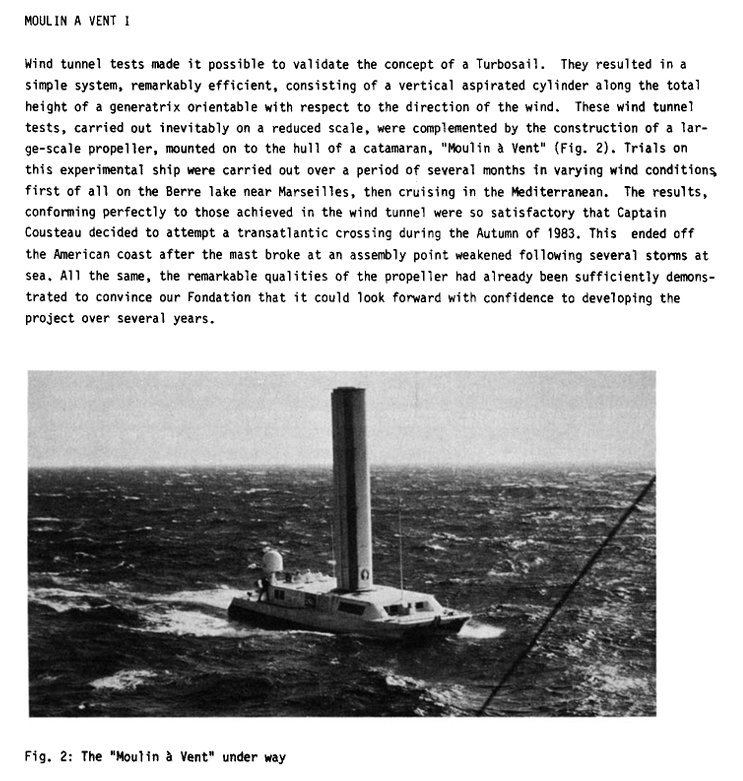
The earlier overview places the trials first at Étang de Berre and then in the Mediterranean, followed by an attempted Atlantic crossing in autumn 1983. It reports the mast breaking at an assembly point after storms. The sea-test section relates the loss to damage to reinforcements at the Turbosail’s base in heavy seas. These are the authors’ descriptions of the failure; the paper does not provide a separate forensic investigation or a day-by-day voyage log.(p. 41; p. 54)
05 / THE PUBLICATION’S PERSPECTIVE
THE PAPER IN THE DEVELOPMENT TIMELINE
The opening sketch of a future Calypso II is a proposal, not a picture of Alcyone. Elsewhere, Alcyone is described as a distinct experimental vessel under construction, with two Turbosails and diesel propulsion. Its scheduled April 1985 launch, subsequent Atlantic passage and intended research and filming work are presented as plans. Reading those future-tense passages as completed voyages would change the meaning of the source.(p. 40, figure 1; p. 42; pp. 54–56, figures 17–18)
The paper connects profile development, a new hull and proposed integrated controls, but does not trace every Alcyone design choice to a particular Moulin à Vent incident. Its conclusion still anticipates further experiments aboard Alcyone and a commercial carrier. It captures the move from one test platform toward additional applications while leaving important validation work ahead. Later operational accounts belong alongside this source, with their different dates and purposes kept clear.(pp. 49–55; p. 57; pp. 59–60)
06 / RESEARCH BOUNDARIES
WHAT THIS SOURCE DOES NOT ESTABLISH
The Marseille passage establishes how the authors describe obtaining the experimental platform. It does not supply a construction certificate, a sequence of owners or a record of later alterations. Nor can the photograph of the vessel underway, by itself, establish an uninterrupted chain of physical identity through subsequent decades. Those are separate provenance questions requiring additional records.(p. 41, figure 2; p. 54)
The document also does not establish Alcyone’s later operational fuel savings or certify the modern vessel’s condition. Its measured aerodynamic results, author interpretations, ship simulations and planned demonstrations answer different questions. Keeping those categories separate makes the paper more useful: readers can identify what was actually tested, what the team inferred, and what remained to be checked when this account was written.(pp. 49–54; pp. 57–60)