01 / DEPARTURE
TANGIER TO THE ATLANTIC
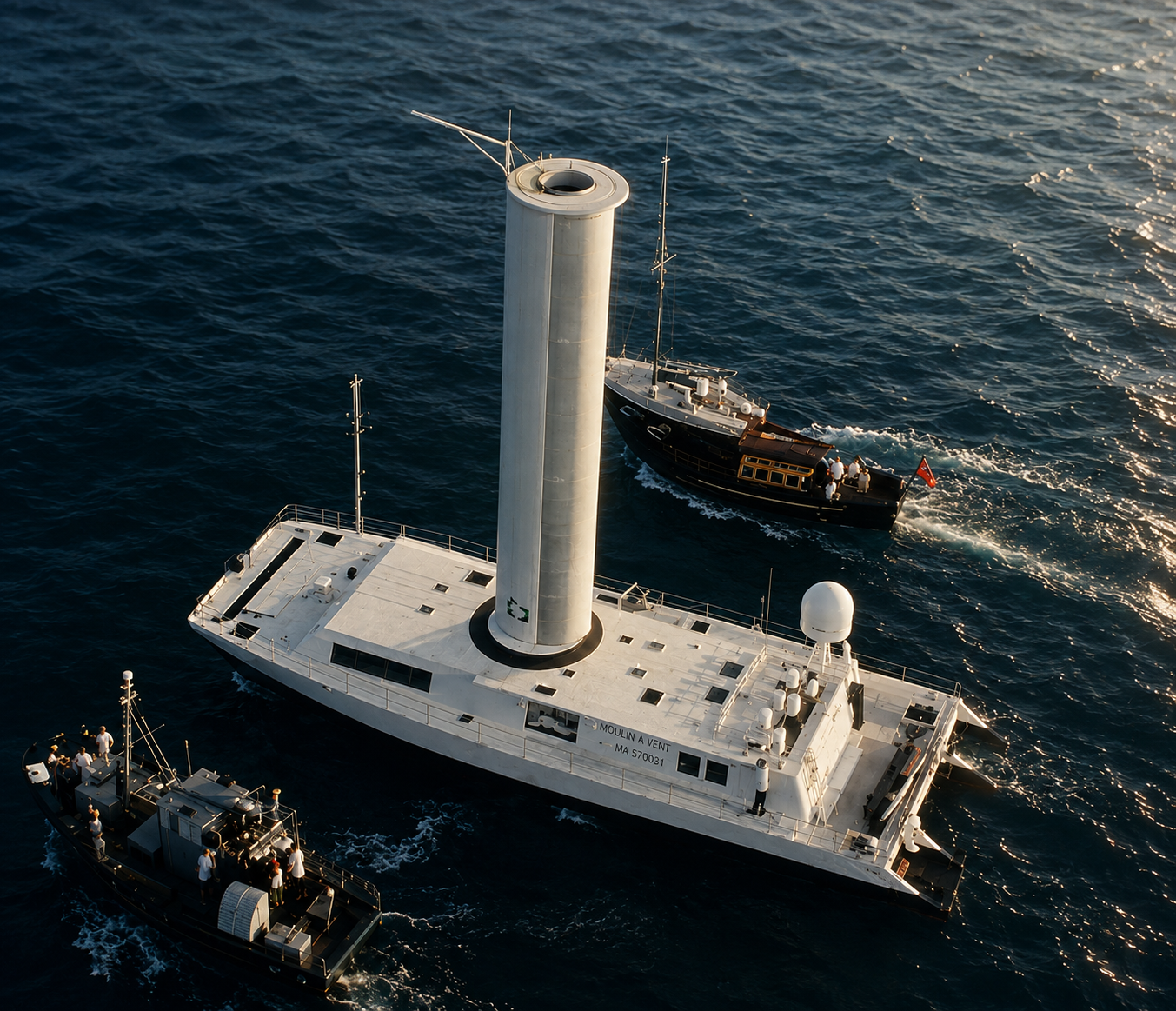
Following earlier trials at Étang de Berre and in the Mediterranean, Moulin à Vent departed from Tangier in autumn 1983 for a full-scale ocean test of the experimental Turbosail system. No exact departure date is asserted by the surviving sources currently in the archive.
The catamaran headed west through the Strait of Gibraltar with conventional engines available as part of the combined propulsion arrangement. The passage moved the prototype beyond controlled regional trials and into prolonged, variable wind and sea conditions.
VIEW THE HISTORIC ROUTE →TANGIER // DEPARTURE
The full-scale ocean experiment begins.
WESTBOUND EXPERIMENT
The prototype moves beyond Mediterranean trials.
EAST OF BERMUDA
Severe weather is reported; Calypso departs to assist.
BERMUDA // REPAIRS
Further work precedes continuation of the crossing.
EXPERIMENTAL MAST LOST
The vessel continues under engine power.
NORFOLK // ARRIVAL
Moulin à Vent reaches Virginia.
02 / EAST OF BERMUDA
WEATHER, DAMAGE + ASSISTANCE
Contemporary UPI reporting records Moulin à Vent in difficulty hundreds of miles east of Bermuda after severe weather. Calypso traveled to meet the experimental vessel carrying people and repair equipment, and assistance was provided at sea.
Temporary work enabled Moulin à Vent to reach Bermuda. Repairs then continued there as a distinct stage of the passage; a November 12 UPI dispatch reported that Cousteau intended to continue the transatlantic crossing after that work.
03 / THE LOSS
THE EXPERIMENTAL MAST GOES OVERBOARD
A November 17 UPI dispatch records that the experimental mast had been blown overboard in gale-force winds east of the United States. Moulin à Vent continued toward Norfolk under engine power.
The loss ended this particular experimental installation, but not the broader Turbosail program. It exposed structural and operational challenges at ocean scale without establishing that the aerodynamic concept itself had failed.
04 / ARRIVAL
NORFOLK
Contemporary UPI reporting records Moulin à Vent arriving in Norfolk, Virginia, on November 20, 1983. After the loss of the experimental rig, the vessel completed the passage under engine power.
The crossing became more than a demonstration. It placed a full-scale experimental system into ocean service and exposed engineering limitations, structural demands and operational challenges that controlled development could not reveal in the same way.
05 / THE RESULT
AN EXPERIMENT, NOT A FAILURE
Moulin à Vent demonstrated that the aspirated-sail concept could be operated at full marine scale. The Atlantic experiment also revealed the demands and limitations of this prototype installation under prolonged real-world conditions.
Experimental programs are valuable because they make those limits visible. The Turbosail research continued, and Alcyone represented the next purpose-built stage of the program; the surviving record does not support attributing every later design decision to one specific event aboard Moulin à Vent.
EXPLORE THE PATH TO ALCYONE →