01 / THE PRINCIPLE
AN ASPIRATED SAIL
The Turbosail—Turbovoile in French—was conceived as a largely fixed, actively controlled aerodynamic structure rather than a conventional fabric sail. Wind moving around its shaped vertical profile produced aerodynamic lift.
A movable control flap and controlled aspiration—air drawn through the system—were used to influence airflow around that profile and help establish a useful working direction. Depending on the vessel's heading and the wind, part of the resulting aerodynamic force could be directed into forward thrust.
The objective was not to recreate conventional sailing. The Turbosail was intended to work alongside engine propulsion, using wind-assisted propulsion to reduce reliance on fuel when conditions allowed.
HOW IT WORKS.
WIND
Airflow approaches the Turbosail.
AERODYNAMIC PROFILE
The vertical structure shapes airflow around its surfaces.
ASPIRATION / SUCTION
Air is actively drawn through the system to influence airflow around the profile.
CONTROL FLAP
A movable flap helps control aerodynamic behavior and the sail's useful working direction.
LIFT → THRUST
The resulting aerodynamic force includes a forward component that assists vessel propulsion.
02 / THE DIFFERENCE
NOT A FLETTNER ROTOR
Both systems seek useful propulsive force from the wind, but they do not work in the same way. A Flettner rotor continuously spins a cylinder and develops lift through the Magnus effect. The Cousteau Turbosail used a largely fixed aerodynamic profile, active aspiration and a movable control flap.
FLETTNER ROTOR
Rotating cylinderMagnus effectTURBOSAIL
Largely fixed aerodynamic profileActive aspiration + control flap03 / THE PROGRAM
FROM RESEARCH TO FULL SCALE
The 1985 technical record places Jacques-Yves Cousteau, Lucien Malavard and Bertrand Charrier within a wider Cousteau Foundation and Pechiney development program supported by engineers and researchers. The work progressed from theoretical development and wind-tunnel testing toward a marine installation at meaningful scale.
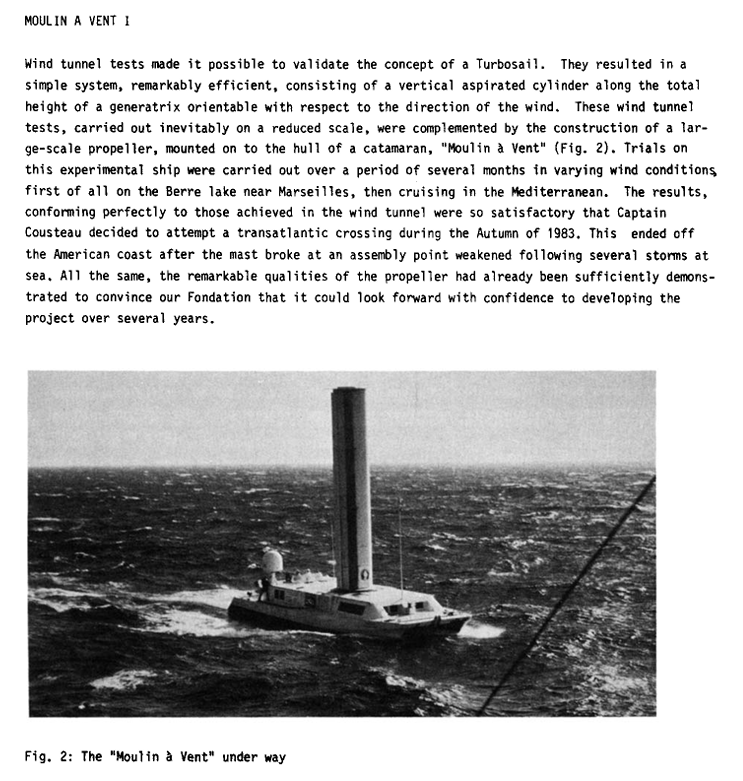
Moulin à Vent provided the full-scale experimental vessel needed to determine whether the concept could function outside the laboratory—in variable wind, sea and operating conditions, and alongside conventional propulsion.
04 / THE PROTOTYPE
MOULIN À VENT
Bureau Mauric's later retrospective identifies Moulin à Vent as the prototype Turbosail boat and dates the experimental conversion to 1982. The 1985 technical record describes trials at Étang de Berre near Marseille and subsequent operation in the Mediterranean.
Those 1982–1983 trials moved the Turbovoile from controlled research toward sustained marine use and the 1983 Atlantic experiment. Moulin à Vent is historically important because the catamaran was not merely carrying the system: she was the full-scale platform through which it was tested at sea.
EXPLORE THE 1983 ATLANTIC EXPERIMENT →05 / THE SEA TESTS
THE EXPERIMENT MEETS THE OCEAN
At sea, the installation had to operate through changing wind angles, vessel motion and structural loads while working in combination with engine propulsion. This was the difference between validating an aerodynamic idea under controlled conditions and learning how an experimental system behaved over prolonged marine operation.
Contemporary reporting records severe Atlantic weather during the 1983 passage and the eventual loss of the experimental mast and Turbosail installation. That loss describes the failure of that prototype installation; it does not establish that the aerodynamic concept itself ended there. The wider Turbosail program continued afterward.
READ THE 1983 VOYAGE RECORD →06 / THE APPLICATION
THE PATH TO ALCYONE
Moulin à Vent was the full-scale experimental platform. Alcyone, launched in 1985, was the purpose-built expedition vessel that carried the evolved system into sustained service.
Alcyone combined twin Turbosails with engine propulsion aboard a ship designed around exploration, science and filmmaking. The transition from one vessel to the other makes Moulin à Vent an essential part of the record: the prototype through which the idea met the sea before its operational application travelled farther.
EXPLORE MOULIN À VENT + ALCYONE →