01 / THE EXPERIMENT
A PROTOTYPE GOES TO SEA
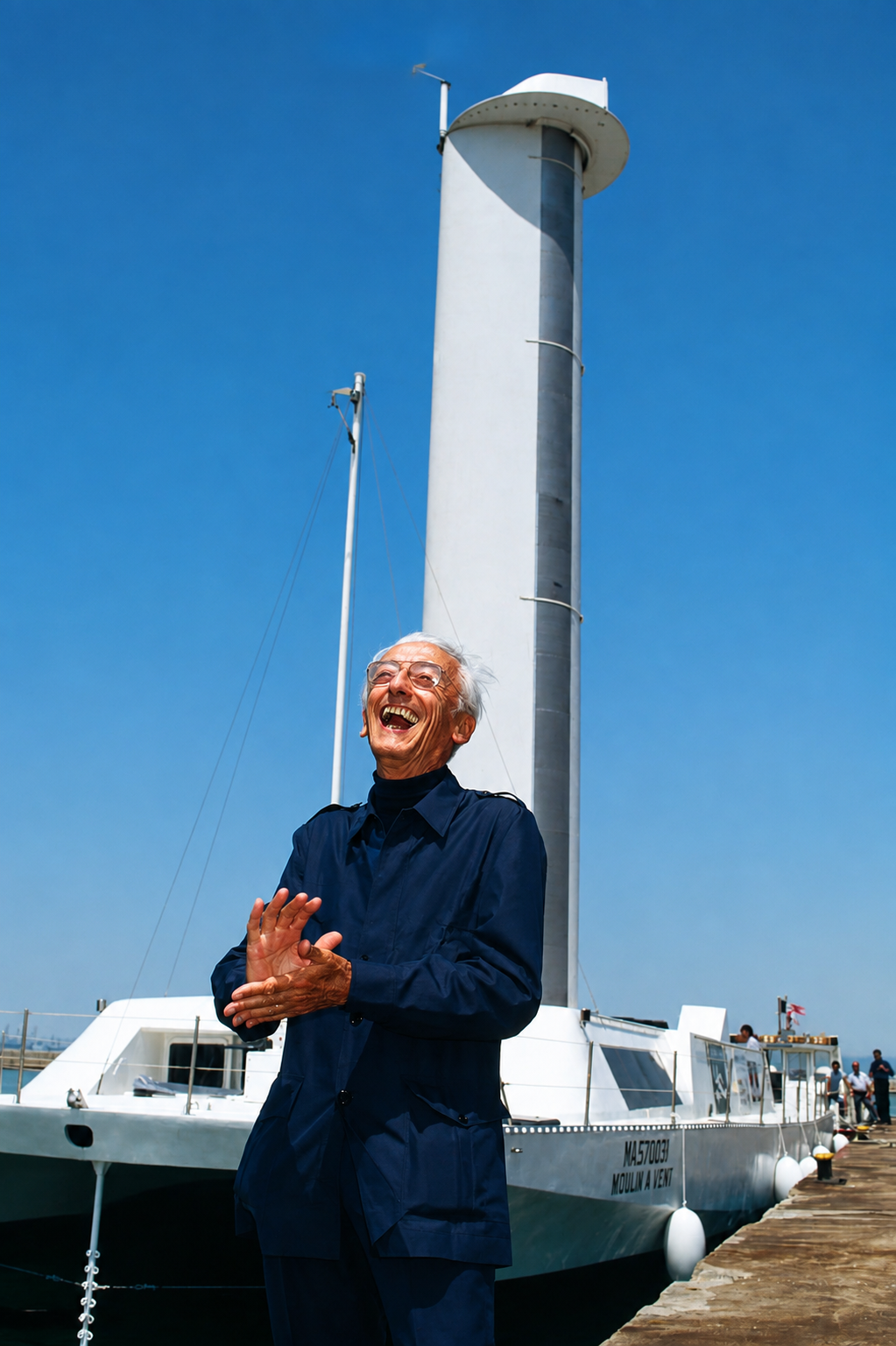
The 1985 wind-engineering paper documents a progression from theoretical and wind-tunnel research to full-scale trials. Moulin à Vent entered the Cousteau–Pechiney program as the marine test platform for the experimental aspirated sail system that became known as the Turbosail.
The catamaran was not merely a support vessel carrying an invention. The vessel itself functioned as the prototype: hull, engines, controls and the tall Turbosail installation were tested together during Mediterranean operation under variable, real-world conditions.
EXPLORE THE TURBOSAIL →02 / THE ATLANTIC
A SYSTEM TESTED BY WEATHER
During the 1983 Atlantic experiment, Moulin à Vent traveled from Tangier toward Bermuda and the United States. Contemporary UPI dispatches published between November 4 and November 20 record severe weather east of Bermuda, Calypso's departure to assist, repair work in Bermuda and the continuation of the passage.
UPI reported the loss of the experimental mast on November 17. Moulin à Vent then continued under engine power and arrived in Norfolk on November 20. The loss ended that installation, but not the wider line of inquiry: the Turbosail development program continued into the purpose-built Alcyone.
READ THE 1983 VOYAGE RECORD →03 / THE YEARS BETWEEN
THE PUBLIC RECORD THINS
Moulin à Vent survived the experimental period, passed through later ownership and underwent modifications. The surviving historical chronology becomes less complete after the Turbosail program: exact ownership dates, the sequence of changes and parts of the vessel's movement have not yet been established through a continuous primary record.
The current archive therefore distinguishes documented events from later recollection and modern observation rather than filling those gaps. What is established by the present project is that the altered but recognizable catamaran survived and eventually came to rest in the Florida Keys, largely removed from the public awareness that surrounded the original trials.
04 / THE NEW RECORD
REDISCOVERED, NOT RECREATED
The modern preservation effort began after the surviving vessel surfaced in an online listing. Identification drew on historical and contemporary photographs, dimensions, surviving structural features, comparison with the experimental vessel, archival research and vessel documentation where available.
The project is preserving and rebuilding the surviving historic Moulin à Vent—not constructing a replica. The objective is not to freeze the vessel in 1983, but to carry the original platform into a new working role supporting research, conservation, education, documentary work and expedition use.
READ THE REDISCOVERY RECORD →